FightCamp: A Name Change, A Game Change
About this episode
 Spotify
 Apple Podcasts
When Khalil Zahar and Tommy Duquette first pitched their boxing workout startup, Hykso, the investors saw a big opportunity. They wanted to know: Could Hykso be more like Peloton, an at-home cycling system that was starting to take off? Three years later, the company is trying to do just that — and it’s been a wild ride.
Today's investors are Jillian Manus, Phil Nadel, Howie Diamond and Jake Chapman.
The Panel

Forefront Venture Fund
“When I'm investing, I'm looking at it strictly as a return on investment.”

“Every company is a good investment at the right price.”

Pure Ventures
“I started my fund because I think I can identify talent and read people really well. At the early stage, I'm mostly betting on people.”
From Gimlet, this is The Pitch. I'm Josh Muccio. So about three years ago when The Pitch was just a little scrappy podcast, we had a little scrappy startup on the show called Hykso. It was a wearable technology for working out. Well, The Pitch is a bigger scrappy podcast now, and Hykso isn't even called Hykso anymore, and that's about the least of the changes that the company has gone through.
So we figured it was time for an update. We're gonna play you the original pitch with founders Khalil Zahar and Tommy Duquette, and then we'll find out where the company is now. All right. Here's the original pitch for Hykso.
Khalil: We produce wearable technology and we allow people to play combat sports without having to hit each other in the face.
Jillian: Phil, you’re a moron. I have to tell you, and I never say that, but -
Phil: Did you call me a moron?
Jillian: Yeah, I did.
Today two founders pitched their wearable fitness technology, basically a Fitbit for boxing. Will investors decide that their device is a heavyweight?
Phil Nadel is the founder of Forefront Venture Partners. In pitches, you'll hear him put the focus on the hard numbers.
Phil: I don't like the model. I'm not seeing the path to recurring revenue.
Jillian Manus is here representing Structure Capital. She tends to only go in on companies when she really understands and appreciates what they're doing.
Jillian: I see the merit. I just wanna make sure that I always add smart money, just not money.
Jake Chapman's here with Gelt VC. He looks for founders who have thought through all the small, boring details.
Jake: There are a ton, a ton of operational issues that you haven't had to address yet. I think you can address these issues, but we haven't seen that yet.
Howie Diamond founded the VC firm, ranch Ventures. He looks for scrappy founders who, come hell or high water, get the job done.
Howie: It's just one of my things as an investor, I wanna know that you can build something that's actually functional.
Here we go.
Khalil: Let's jump into it. I think it's a good time. Well, thanks a lot for having us guys. So my name is Khalil. I'm the founder of our company that is called Hykso. We produce wearable technology and we allow people to play combat sports without having to hit each other in the face.
Basically, Hykso is a chip you can wear on your wrist, sort of like a Fitbit, but instead of measuring steps or how many flights of stairs you've climbed, it counts punches: how many punches you've thrown, what kind of punches, and how fast they were. So if you were taking, for instance, a kickboxing class, you could see how you were measuring up.
Khalil: But we realized that a lot of coaches out there are trying to always gamify those classes and trying to keep score, basically, and they have no way to do it. And right now the best thing available is a company called Myzone, which is actually a heart rate monitor that displays the heart rate directly on TV.
Here's Tommy, the other founder.
Tommy: The heart rate is a very - it's a tough way to measure output, first of all, right? Because it's subject to so, so many external factors, whether it be stress or caffeine.
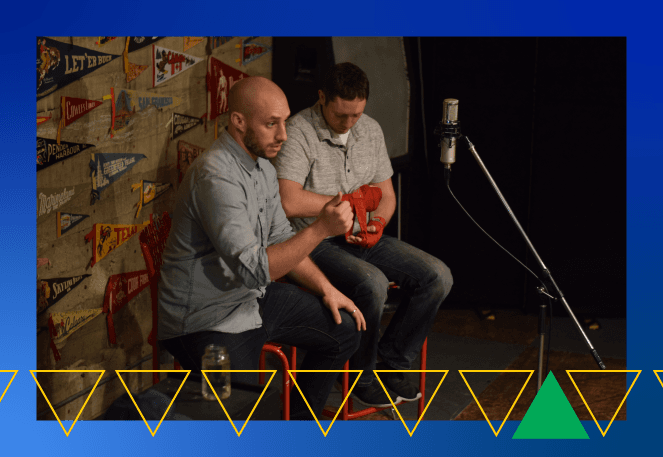
Tommy's the muscle in this co-founding team. No, literally. His hands are wrapped like he's ready to step into the ring. And on his wrists, hidden under the wrap, sits the technology that brings everyone here today.
Khalil: And the competition aspect is really what excites us because you can now create a circuit -
Jillian: Right.
Khalil: - and connect all of those locations together within gyms, for example.
Howie: I guess I'm having trouble - can you guys just like very concisely tell me where you guys - where this company started, where it is today -
Khalil: Yeah.
Howie: - where you see it in the future and what's actually built up to now.
Khalil: Right.
Howie: That'd be helpful.
Khalil: It started three years ago and the idea was just for myself. And then we had a lot of traction with the professional athletes. Because we were working with the national team of Canada, they needed very high accuracy. And basically what was - took the most of our time to develop this is that you have to filter all the different types of data. If you do jumping jacks, you don't wanna count punches. If you know, clap your hands, you don't wanna count punches. And that was a very big challenge because most…
Khalil and Tommy explained that because they started out working with the Canadian Olympic boxing team, the process of refining their wearable technology took a while. They needed it to be precise in measuring punches and punches only. But finally they got it right and it was then that they decided to take their product to a bigger market.
Howie: Target demographic is boxers and boxing gyms today?
Khalil: No, it's actually wider than that. Right now, the target market when it comes to the users is actually women between 25 and 40 years old. They're the big market when it comes to fitness.
Tommy: It was a pivot to go to the gym model. It just makes a lot more sense for us.
Rather than marketing to individual consumers or to teams like the Canadian boxing team, the new plan for Hykso is to sell directly to gyms. This way, athletes taking classes like kickboxing and MMA can all use the wearables and keep track of their progress. The question is, how well does the technology actually work?
Khalil: You guys wanna see a demo?
Tommy: Yeah. I wanna show you a demo too. I'm dying.
Jillian: Yes. Yeah.
Khalil: Yeah. So, do you wanna hold the phone for me -
Howie: You'll be working with Jake for the demo. He'll be your sparring partner.
Tommy: Show them that, too. So -
Jake: Take it easy. Not the face.
Howie: It would've been -
Tommy: Not the face. This is the money maker right here.
The sensors are in here that - he's holding the charging dock. Both sensors go within that charging dock and it's - it doubles as a carrying case for you.
Tommy is showing the investors the sensor, which sits inside the wrap that goes underneath his boxing glove.
Tommy: So punch harder, punch faster, punch more, you maximize that intensity score. So I throw a punch. How many punches am I at right now, Khalil?
Khalil: Thirteen.
Tommy: Fourteen.
Jillian: Right.
Tommy: Fifteen. Sixteen. Seventeen.
Tommy is throwing punches now showing investors how the Hykso sensor can pick up the speed, velocity, and type of each punch.
Jillian: Its velocity…
Phil: So we need more, a little more velocity.
Jillian: Right.
Phil: Come on, man.
Tommy: I'm retired.
Phil: Let's get it over twelve. Oh, intensity, through the roof. Off the charts.
Tommy: See what the social pressure does? Imagine in a gym setting, right when -
Phil: You’re off the charts.
Tommy: It pushes you to work.
Phil: You’re talking and the intensity is dropping.
Tommy: So imagine you're in a gym setting now, right? An individual, you have that social pressure. The other modes we have are super interesting too. So imagine you can take the gym now, right, and you split the class into two teams or four teams, right, of equal size. And now you have team one, team two, team three, team four, coming together to beat one another.
Phil: And you can tally it by team.
Jillian: Oh yes.
Tommy: The six o'clock class coming together to beat the eight o'clock class. Because in a gym - so I spent a really long time in fitness myself. The holy grail in a gym is community. If you can get that community feel in your gym, strengthen those relationships, you drive retention through the roof.
As a rule, investors love seeing a live demo, and they view it as kind of a first hurdle. If the founders can nail the demo, then they'll move on to the tough questions.
Jillian: Could not any of the other Fitbit or the wearable companies come out with this? I mean -
Tommy: Good question, but it's extremely difficult. So what the Fitbit does, it's a, you know, it's a pedometer, right? So if there's an event, it says there was an event. If there was any kind of movement, right? What we do -
Jillian: Yeah. But Apple's also working on things. I mean, they're all - I'm not just saying Fitbit. I'm saying wearables as general, in general, as a category, right.
Tommy: So, so what we do is full 3D motion tracking, the sensor knows its position in time and space 1000 times per second.
Jillian: Right. But it can be done by any one of the wearable companies.
Khalil: And, you know, honestly, when it comes to a Fitbit, the angle of the product is completely different.
Jillian: No.
Phil: No, but - she used it as an example. It doesn't -
Jillian: Yes. Fitbit is not an exact science.
Phil: Let's say I started, you know, Phil's boxing sensor company. And I did the same training -
Jillian: Hire somebody, an engineer.
Phil: - machine learning. What’s proprietary?
Khalil: You know, this - the - what is proprietary is actually the algorithm. When it comes to the sports that are very dynamic, it is actually complex to be able to filter what is a relevant motion than a not relevant motion. It's hard to know if, you know, there's not other brains out there who can do that. We know HBO worked for two years on a similar product. It wasn't able to pull it off.
Phil: Are you thinking of doing like a Peloton for boxing?
Khalil: Yes, exactly. At a certain point, we wanna allow people, even at home, to connect with the people in the gym.
You might have seen the commercials for Peloton.
Peloton ad: This is what you woke up for. This is your Peloton.
It's a $1,200 stationary bike that comes with a big screen and you ride it in your home. They have a $50 monthly membership that lets you tune in to live classes.
Phil: To me, that makes a lot more sense than even having to go to the gym. I'll stay at home, like I do with my Peloton, and I'll go online and do an interactive class or compete with other boxers.
Khalil: Yep. Absolutely.
Phil: That's smart. I really like that idea because well, firstly, Pelotons killing it.
Khalil: Yeah.
Phil: You know. And with your model, they don't have to buy expensive hardware. They have to buy sensors that are a hell of a lot cheaper.
Tommy: Absolutely.
Phil: And they can get a great workout and still have that interactive training. And you have leaderboards and the whole thing. So that's smart.
Tommy: And not just that, but you know, I think the at-home fitness market has always been more geared towards women. It's been more - women have been more accepting just, you know, as an overall, of the at-home fitness market. It's obviously a huge opportunity right now.
Jillian: Do you know why?
Tommy: No.
Jillian: It's because Jane Fonda.
Tommy: Right.
Jillian: Jane Fonda really opened our eyes into basically taking responsibility, and that was the first ones. And then Cher and all the other ones filled up, but it was really introduced to women first. That's why. And then men were a little bit off put on it. Well, that's too, you know, that's too girly and all of that. But now with all the, what is the -
Khalil: Tae Bo was another one as well.
Howie: For the record, I had a jazzercise party when I was three, so I was into it.
Jillian: Did you have a jazzercise –
Howie: Jazzercise.
Jake: I can see that. That’s cool.
Phil: My opinion of you has changed dramatically now. I've learned something here today.
While Howie might be the lone enthusiast for jazzercise, all of the investors sound like they're getting kind of excited by the idea Phil brought up, of Hykso as a product that you could use at home.
Jillian: So how does this fit into that model? Because you don't have really the workouts, do you? You just, it’s just the device right now. It’s just a sensor.
Khalil: So we don’t provide the workouts for now, right? Yeah. Our first focus right now -
Jillian: Is the sensors?
Khalil: No. It's actually going into those gyms. Because that demand is there. So we signed two LOIs and one was actually with the fastest growing franchise in 2015 in the US.
Jillian: Which one?
Khalil: It's called Title Boxing Club.
Jillian: Oh, yeah.
Khalil: Yeah.
Jillian: I know that.
The thing Khalil is bringing up, LOI or letter of intent, this is a smart move on Khalil's part. He's taking control of the conversation, moving investors into an early success story. Title Boxing Club recently signed a letter of intent, an LOI, basically saying that if Hykso builds the sensors and leaderboard app for the gyms, they will buy it.
Khalil: And they're expanding super fast right now.
Jillian: Yeah.
Khalil: And they basically were looking into Myzone, but they didn't like the fact that, you know, it was irrelevant for boxing. But now, you know, with our system, they can measure output, which means that they can rank all of their members and create links between all of their locations. So that creates a bigger sense of community with all of their members, and you become part of the Title Boxing circuit.
Tommy: We recently signed an LOI with CKO Kickboxing as well. I don't know if anybody's heard of them?
Jillian: Yes.
Tommy: They put out a press release yesterday. The COO just texted me today. He said –
Jillian: Lines all lit up.
Tommy: Reaction is, yeah, it’s just off the hook.
Phil: What do you think the value of that LOI is?
Tommy: Two million.
Khalil: Yeah, it's around two million.
Phil: Okay.
LOIs worth $2 million is nothing to sniff at, though it's worth distinguishing that LOIs are not contracts. Still, they could turn into contracts if everything goes right for Hykso. The question on all the investors' minds now is, assuming this does work, how big could Hykso really get?
Jillian: Do you think this is going to be a trend? Is this trend sensitive?
Khalil: You know, it's hard to say. You know, I don't believe so. You know, spinning has not been a trend, although we started in -
Jillian: Oh, it's a trend now. It wasn't.
Khalil: It wasn't, but it's constant now. It's pretty solid now.
Phil: Let's distinguish between trend and fad.
Khalil: Right.
Phil: Are you talking about a fad that's gonna come and go? Or are you talking about something that's -
Jillian: Actually, that's a really good question. I'm thinking more like a fad.
Phil: A fad fades quickly.
Jillian: Yeah. Like we didn't see, I mean, now - Tae Bo was the, you know, was everything. And now, it's gone. I mean, everything comes and goes, and so -
Phil: Howie, what about jazzercise? Is that gone?
Howie: Well -
Phil: How’s that going for you?
Howie: I do host some jazzersize parties once a quarter at my house.
Phil: You're still doing that? Okay.
Howie: It's more for nostalgic purposes.
Jillian: I mean, I know boxing’s up, but boxing actually as a sport has also hit a low. Not in terms of fitness, but in terms of -
Khalil: But survived more than a 120 years already, right, of popularity.
Phil: MMA is more popular than -
Tommy: MMA is exploding.
Phil: That's picked up the slack more than anything.
Khalil: And then the way we see it when it comes to, you know, those fads, is we look at, you know, what happened with running? Which was really got popularized in 2005, saw the peak growth, everyone started running, 2005, like people didn't run before.
Jillian: Yeah. Yeah.
Khalil: And then you had all those companies like Strava, you know, Runkeeper, that all suddenly came out.
Jillian: Right.
Khalil: And then you had the same thing in spinning in 2012 and 2011, where they saw the peak growth. And then you had SoulCycle and Peloton.
Jillian: Right.
Khalil: And then in 2015, there's like multiple analysts in fitness that are saying that combat sport is the new thing.
Jillian: But I'm wondering is it a new fad where this only has a little bit of, you know, it's gonna peak similarly? And then -
Khalil: If I would have the answer to that honestly –
Jillian: Yes, I know, I'm just –
The conversation is moving in a direction that Khalil and Tommy aren't totally comfortable with: debating whether or not contact sports is a fad or a trend. So Khalil gently nudges investors towards something a bit more concrete. Past sales.
Khalil: Basically, when we learned that the sale cycles were so long, and that was actually last January, we decided to do a pre-order campaign. That was in March and we sold, in four months, we sold 2,500 units. It's $360,000.
Howie: What'd you do it through?
Khalil: Directly on our website.
Howie: Through your website.
Khalil: Okay. Yeah. We didn't think our community lived on Kickstarter.
Howie: Mm-hmm. So you pre-sold this next generation product?
Khalil: Yeah, that we're shipping in 12 weeks now.
Howie: Okay.
Phil: How many did you sell?
Khalil: 2,500 units.
Howie: And it's just the sensor?
Khalil: Just the sensor, the mobile app. It’s direct to consumer. And then in the meantime we got all those discussions with those big gyms. So one LOI with Title Boxing Club. It's a $4 million LOI.
Jake: And then what's your cost to make a pair of sensors?
Khalil: $32 landed.
Jake: $32 landed. Okay.
Tommy: And it'll go down over time.
Jake: I mean, in terms of hardware development, it's basically just, it's done, right? They're making the product, like final designs are done.
Khalil: We already, we already pressed the green button with Arrow. Arrow is our manufacturing partner, and they financed the first production run.
Howie: So you didn't have to pay anything up front?
Khalil: Exactly.
Howie: They covered all the costs?
Khalil: Yeah, exactly. So they offer a line of credit of 175K. But -
Jake: I like you guys are being scrappy with the cash flow. You've got Arrow doing the development, you pre-sold units.
Khalil: Exactly.
Phil: So total revenues, how much?
Khalil: I'd say right now we're about like, you know, 405.
Phil: How much are you raising and what terms?
Khalil: 500k. And we raise under a SAFE capped at 4 million.
Jillian: Oh, that's really good.
Hykso is valued at 4 million, and Khalil and Tommy are trying to raise a half a million dollars from investors to get their sensors perfected, shipped and hopefully into gyms.
Phil: How much of that has been committed so far?
Khalil: 175.
Phil: From whom?
Khalil: So from, you know, we have 100k that is from friends and family and the rest is from angels.
It's decision time. Have Khalil and Tommy talked up these LOIs enough to get investors on board with Hykso? Here's Howie.
Howie: I mean, thanks for the demo. That's like actually rare for us to see a working demo. You know, you guys built something that seemingly just works, which is awesome. And for this space, it's, it seems like it is underserved and it feels like you guys are solving a problem.
To me, I worry about like the total adjustable market, like the TAM. I think for me it's a little too narrow, so I'm gonna pass.
Tommy: Yeah. Right, right, right.
Jillian: Phil.
Phil: Yes, Jillian?
Jillian: Really?
Jake: Phil's taking notes. All good.
Apparently, Phil's undecided. Here's Jake.
Jake: You know, I do box for fitness. I think it's an enormous amount of fun and it is like the hardest workout like you could possibly get. I mean, like, on days when I feel motivated, like I want to puke at the end of it. And, but like, it's in a good way.
I don't think it's a fad and maybe that's just because like I'm in it, like I really enjoy it. I think if I had these at my gym and I were doing it and like I showed someone an app, like other people would want the sensors. And I know that's not the market you're going for, because you want sort of the gyms to buy it. So I think it could work. So I'm in. I think this deal's a real knockout.
Jillian: Oh!
Phil: I was, I had that one queued up. I totally had that one ready.
Jake: We're working on puns. We're really, we're working on puns.
So we're a smaller fund, but like I definitely wanna be in. I think probably a 25K commitment from us. I think there's a future here. I think you can become something like a Strava or a Peloton. So.
Tommy: Absolutely. Thank you. Awesome.
Wow. So Jake's in for 25K. Let's find out if Phil has made up his mind yet.
Phil: I gotta tell you, I'm still on the fence. I really like the idea of the Peloton model. But that's not what you're targeting right now. Because what you're targeting makes a lot of sense and - but it also requires sell through. And that's why, you know, for a sort of early stage like this, where it's pre-delivery of the product, there's so much more risk. If for some reason the numbers don't bite, then the thing falls apart. So, lemme ask you this: on the two big LOIs, is the hardware component of those set in stone? Is that guaranteed?
Khalil: It's not guaranteed. Since it's an LOI, you know, to be completely fair. But -
Phil: So what are the terms under which - I mean, they can cancel at any time at this point?
Tommy: Yeah, it's an LOI.
Howie: If it goes to contract, what is, what are the terms?
Tommy: All the terms that are laid on the LOI, so…
Phil: So why isn't it a contract? I mean…
Tommy: We're shipping in a month.
Phil: Yeah, but - I mean, you can have a contract now.
Khalil: The biggest doubt of all of those customers is that it works.
Phil: Well, that's my doubt, too.
If you've been paying attention to past pitches, you know Phil is our most cautious investor. He tries to nail down every single detail before he puts a cent behind a startup.
Phil: So you've shown them this demonstration that you showed us.
Tommy: That's how we - yeah, that's how we -
Phil: And they were like, wow, that's great. So they see that it works. So what are they concerned about? That it won't get up on the TV screen?
Jillian: Is it integration?
Khalil: It's honest - that's an honest, that's honest pushback that I've -
Phil: That's what they're saying? We see it gets on the app. We're not sure you're gonna get that information up on the phone? Up on the TV, I mean.
Khalil: Because they didn't see the exact, yeah, they didn't see the exact context with 15 people, for example, doing it at the same time.
Phil: I just wanna understand, what's the timing for getting these LOIs to contract? Do you have to deliver product first? Do they wanna see it, actually?
Khalil: Yeah. I think those will actually be done, you know, I'd say six weeks after first shipment. So I'd say within the next four months and a half.
Tommy: Right. Yeah.
Phil: I'm gonna pass for now. In four-and-a-half months, if there are contracts, I'm in, even, you know, if it means a higher valuation at that point. Because at this stage - I really like what you're doing. I really do. This is very tough for me. But I just feel like there's this big question mark there.
Tommy: Seed stage is maybe a little bit too early for you right now.
Phil: Pre shipping is a little early.
Tommy: Yeah.
Phil: And this is - I'm trying to make an exception here, but.
Jillian: I don't think they would've manufactured all these if they didn't really feel confident that these LOIs are going to turn into contract.
Phil: Oh, I don't doubt that they feel confident.
Jillian: Yeah. Okay. Can I just say one thing? I just wanna just address one of your concerns. I think they're doing it the right way, where they have the gym marketing dollars behind them and the adoption will be in the gym, and then they can expand it into at home.
Phil: Right, right.
Jillian: So I think at a $4 million valuation - I'm not trying to convince you, but I would think that going direct to consumers is probably not the best way to go. And I'll tell you why. Because the reason why this in-home spinning has done so well is because of SoulCycle and all the other gyms that launched SoulCycle. So people started to be introduced through the gyms and through these franchises. And then it enabled companies to come in and start the home, okay.
Phil: Yes. Good point.
Jillian: Yeah. And so that said, okay, I'm gonna pass and I'll tell you why. And it has nothing to do with me not being completely excited about this at all. It's because I don't invest into devices. I don't do wearables or anything like that. I don't know anything really about this. And so I never invest in something I don’t know anything about. But I do know about boxing and I do know enough that this is a very hot space and I am positive. I think that this is a huge opportunity for everybody and good for you for taking this because you're gonna be laughing at all of us. I think what you're doing is amazing.
Phil: He already is.
Jillian: Yes.
Phil: I hear him chuckling.
Jillian: I absolutely see this. So, thank you so much. And I think your raise will be pretty easy at this valuation and with this incredible product.
Howie: Phil, wait, Phil, are you still passing or did Jillian convince you to go in?
Jillian: Phil, you’re a moron. I have to tell you, and I never say that, but -
Phil: Did you just call me a moron?
Jillian: Yeah, I did. You are one of the smartest men and I can't believe - and you also do your own, you understand this market, and I see such huge opportunity here. It's killing me. And of all the people, I would think you'd be able to scoop up money for this.
Phil: Jillian, you love the deal. Why don't you make an exception?
Jillian: You wanna know something? It's all -
Tommy: It would be such a pleasure. I really like your vibe.
Phil: Lemme just say, we could, we can do the whole round -
Jillian: You’ll let him do this to me?
Tommy: So here's the thing -
Phil: We can get them, we can get the valuation, lower -
Jillian: The valuation’s already four. I mean, that’s like the -
Phil: Right. I think we do a $3 million valuation and we do the whole thing.
Jillian: Phil.
Phil: 3 million and we do the whole thing.
Jillian: I can't.
Phil: Jillian.
Jillian: It's not your money. It’s my money.
Howie: Phil, you shouldn't need Jillian to go into this deal, to go into a deal.
Phil: I know.
Jillian: Okay,
Phil: So you're out? You're passing. You're done?
Jillian: I'm passing.
Tommy: Oh, that's such a shame. You know business though, very well.
Jillian: Yeah, but he knows it ten times better and he knows this space.
Tommy: So if he comes in, would you be in with him? That way he gets the -
Jillian: What's this like the Trump Hillary thing? You show your emails and he'll share his tax returns.
Phil: What do you want to do on the cap?
Tommy: What do you propose?
Phil: 3 million. I'll do 250.
Tommy: K?
Phil: No, $250.
Jake: Yeah. Take out the wallet. Take out the wallet.
Phil: I got it here for you. I'll close today. I can close now. $250.
Jake: I got cash. Cash money.
Phil: The k, I would have to wait a little bit, but the 250 I can close today.
So Phil is offering to come in for a quarter of a million dollars if Khalil and Tommy will drop the valuation of their company from 4 million to 3 million.
Phil: Jake can ride along at the 3 million. So you get, what'd you -
Jake: Generous. Generous.
Phil: How much did you come in at?
Jake: 25k.
Phil: Okay, so you'd get 275 at three.
Jake: And then Jillian would come in for 25 -
Phil: I think she would do, I think she would do something.
Jake: - because that makes it an even 300,000 on a 3 million cap.
Jillian: Jillian's gonna be a 25.
Phil: There. You got 300,000 at 3 million.
Howie: At 3 million.
Tommy: It is so, so much lower, though. Okay. What do you think?
Howie: Do you wanna phone a friend?
Khalil: Let's do it.
Jake: Phone. Phone a friend? Let's do it?
Khalil: Yeah, let's do it.
Phil: We're doing it.
Jake: Are you phoning a friend or are we shaking on it?
Khalil: Thanks for, yeah, thanks. At four.
Howie: Four.
Jillian: Yours is at four.
Howie: I'll still shake your guys hands. Congrats. Good job.
Jake: Howie’s gonna lose out on this one.
Phil: You did a great job.
Everyone shakes hands and the founders head home with $300,000 in commitments from investors. All it took was some serious strong arming by Phil to get the founders to drop the price of their company to 3 million and convince Jillian to ride along. Now that's some smooth talking.
After the break, we'll catch up with Khalil to find out what's happened with Hykso in the years since his original pitch.
Welcome back to the show. So after The Pitch, Phil and Jillian's investments, they fell through. Phil wanted to go in, but Khalil ended up getting into an accelerator and that delayed his raise. So he put Phil on the back burner, and then that investment never actually came together. As for Jillian, she ultimately decided she didn't know enough about the space to go in on Hykso.
But Jake's investment came through. In fact, it ended up growing from 25K to 125K, and in the three years since Khalil and Tommy walked out of the Pitch room, Hykso has changed. A lot. So I recently talked to Khalil to hear what happened next. He picked up the story where we left off in the spring of 2017.
Khalil: And then what ended up happening is we had some of these trials and pilots in three different, you know, gym franchises. And we had it in Title Boxing Club, we had it in UFC gyms, and then we had it in a bunch of independent gyms as well.
Josh: And like, how did it go?
Khalil: The users loved it. We had 50 locations that were using the new user interface. We had a lot of like, you know, gym owners who were actually putting pressure on the corporate side of, you know, these big franchises to try to get the product adopted faster.
Josh: Uhhuh.
Khalil: And then we were starting to negotiate all sorts of deals that will be like, you know, nationwide expansion. And then basically the deal starts to materialize -
Josh: So it's going well?
Khalil: Yeah, exactly. But what happened is that at the same time that this happens, there's a new opportunity that opens up. Home fitness in itself is like blowing up. Peloton is coming out with the big news of, you know, raising and being a billion-dollar company. It's taking the gyms by storm. A lot of the gyms are now kinda like reacting to that news and to just in general the way the market is changing so rapidly.
The gyms were like, hey, we want some of that in-home workout action. So the tables turned, and this time the gyms had a proposal for Khalil.
Khalil: Like actually the gyms themselves were the ones that actually started asking us the possibility to do a home fitness app, leveraging our technology to make the workouts interactive.
The only thing is, by then, we dealt with them for a few, like, you know, probably about a year and we're coming to the conclusion that they're gonna take forever to actually make it happen.
Josh: Yeah. So, do you remember the moment when you realized, or like things finally came to a head, and you said like, okay, this isn't gonna work out? We're gonna have to find something else to do other than sell to gyms?
Khalil: Yeah. Yeah. I mean, like, I remember that meeting very well 'cause, you know, like I called it. It was a summer day, we were at the office, and we were the whole co-founding team together. And we're like, here's the thing, this new opportunity is so much bigger. And it was to create a home fitness solution that would be completely integrated from, you know, from all the way from the content to the data, to the challenges and the gamified features we would be able to create.
And that's when they started thinking about what it would take to go from their gym product to this massive at-home workout system that they wanted to build. And what they realized is that no one on Khalil's six member team had any experience creating content, especially interactive videos for home workouts. But when you're a scrappy little startup, sometimes all it takes is one person to lead the charge.
Khalil: And Tommy was like, man, I have connections to some of the best trainers we can find in LA and we'll get the best workout these people have ever seen. Like, you know, like he's been training people his whole life, so he was very convincing that we could get - like, this could actually be even a selling point in terms of the quality of the programming.
Josh: Then what did they say in response? Like, did they decide like, yeah, we're ready for this challenge?
Khalil: We were like, man, you know, we're already like struggling, you know, bandwidth wise, and we're six and now suddenly we're adding this whole new layer. It was pretty scary, but you know, at some point it was like a moment where we were looking at each other's eyes, like, what type of company are we really trying to build here? Like, are we trying to just be like an accessory type company that just serves some - or are we trying to really move the needle and create something that nobody else has done before?
Josh: So like you have this meeting with your team where you guys kind of come to this consensus like, we're gonna, we're gonna build content and live classes around boxing for in-home use. And then like, you guys meet the next day.
Khalil: Yeah. And you know, like everyone was like pretty - was like, Hey, as long as we all know we're what we're getting into. This is the plan. And like we designed the timeline as, you know, they would give me a certain amount of time to raise the money, to see if I can raise the money, and then only if I can raise the money then we're changing gear. But if we, if, you know, when we are changing gear, we're changing gear like solid.
Josh: So you gave yourself an ultimatum, or the team gave you an ultimatum. How much time did you give yourself?
Khalil: I think the time that, at the time, was four months.
Josh: To raise how much?
Khalil: We wanted to raise minimum 750 grand.
Josh: Okay.
Khalil: So we ended up closing 900 in three months instead.
Josh: Hey, that's great.
Khalil: Yeah. Yeah. It went pretty well. So.
Josh: So did you… Then what? So like you go back to the team, you're like, I raised this money. Let's do this.
Khalil: Then I came back. We have money in the bank. Everyone drops what they're doing on Hykso. The first thing we do is a branding session. Tommy said, yeah, I really think we should call it FightCamp. I think that's the best name brand. We're gonna get away from all the branding problems we had with Hykso, which was a lot.
Josh: Wait. Wait.
Khalil: Just given how -
Josh: What branding problems did you have with Hykso?
Khalil: Oh man. Like, people like not knowing how to spell it, people not knowing how to say it. You know, we had all sort of – Hisco, Hesoko.
Josh: Yeah, it was a pretty bad name.
Khalil: Yeah. Thank you.
Josh: And I say that as someone who thinks FightCamp is a fantastic name. Much better.
Khalil: Thank you for the compliment.
Josh: Then what happens next?
Khalil: A shit show in the good sense. Yeah. We -
Josh: Wait. How is a shit show a good thing?
Khalil: Yeah. I mean, you know, it was just like the amount of important decision made on one day and then like every day was just like, you know, putting out fires and debates and arguments, but all for the better, you know?
And we were like, okay, as of now, we're meeting every morning at 9:30. And we're -which is, which was early for us. And we had - the overall plan was to first know how to sell it, then we would look for signups, and then we would build a Kickstarter campaign. We wanted to test the product traction that way. Because like there was no point in building anything if we couldn't get any traction on the way we'd sell in.
So Hykso, now FightCamp, has committed to making this major pivot and turning from primarily a hardware company that partners with gyms to a full-fledged at-home fitness company. They've got almost a million in the bank, but before they dive into actually making the thing, they wanna test to see if people actually want it.
So they buy some ads, collect about 7,000 emails, and then they do a test to see, of those email addresses, how many people would actually pay for FightCamp.
Josh: And how did that go?
Khalil: So we had like a much lower conversion rate than we expected.
Josh: How low?
Khalil: I think we tested it with like a thousand people out of the 7,000 emails we had and I think we had like, you know, like three or four conversions. Like very little.
Josh: Ooh.
Khalil: Right.
Josh: That's not enough to launch a Kickstarter on.
Khalil: Absolutely not.
Josh: So the Kickstarter test you guys did didn't work?
Khalil: No. And then we started talking to more users and we realized that a lot of people really wanted to see the workouts and how they'd look before they would actually commit to anything.
Josh: So then you're up against the ropes. What do you do?
Khalil: Yep. So we build workouts. We actually build the whole thing. So, you know, at that point it's like anything goes. We're like, you know, at war and everyone is like part of this Secret Force Delta team that - there's no roles. Just add value, you know? So like someone needs to go and talk to a customer. You do that, whoever that is. We were doing all sorts of stuff, like we were -
Josh: All hands on deck.
Khalil: Some of us were like, yeah, some of us were filming and editing a video themselves, with very little editing background. You know, other people would, you know, like talk to customers because we were trying to keep things cheap and fast. So the best way was to just build everything ourselves. Someone has taken one photography course one day, he's now suddenly making all the photos for the website.
Josh: You took a photography class in high school, right? James, you're on it.
Khalil: Yeah, exactly. You take the camera. Yeah. It's just like, grab a tool and, you know, help, you know.
Josh: it's like you were building a whole new company.
Khalil: Absolutely. Yeah. It definitely felt like that.
After a couple months of this mad dash to create the videos, the moment of truth arrives. The first six boxing videos are ready to launch, and they're pretty much just videos. More Jane Fonda than Peloton. Users would just watch and follow along on their own. Nothing interactive, no leaderboards to compare yourself with other users. It's what they call in tech, the minimum viable product. And they decided not to charge people yet, but they still asked them to sign up and give their credit cards so he could be sure that this time the customers were ready to buy.
Khalil: One day you're getting five signups and it's a huge story, and then another day you're getting 15 and then like at some point you're getting 20 and you're like, oh my God. Like, and these are all people signing up for our solution. And then every morning it's like our eyes are like lightening up. Because if you think of the way we were pricing the gym product, it was $50 per gym location per month. But like, we're charging $39 a month for one person. Like, it's like we just got - by then we had like 300 people commit to a sign up. It's like we had, you know, 220 gyms.
Josh: Oh wow. Just like that
Khalil: All in one month. So like, we were like, that's it.
Josh: Is that the point when you knew that you had something?
Khalil: Yeah, for sure. You know, we were like, you know, like the whole business made a lot more sense, you know?
Josh: So how did, what was the, like big plan? Like did you have a timeline where you're like, we're gonna work on content for the next six months and we're gonna launch with a hundred videos, 200 videos? Or like, while we're building out the technology, like what was the plan?
Khalil: Yeah. So by the end of December we're like, okay, let's build the interactive portion of the app now.
Yes, the FightCamp team was onto the next round. Ding ding ding. Khalil and his posse got to work filming more classes and building the technology to make the app more like Peloton, where you can see how you're measuring up with other people in FightCamp worldwide. And by early 2018, they were ready to make some actual money.
Khalil: And on March 16th, we did. That's the date that we start charging people. And that was a huge day because like we all had bets going. Some people thought, you know, 20 people would still stay and buy. Because we were looking at -
Josh: You guys were taking bets in the office as to how many customers would actually pay for the product?
Khalil: Yeah, we always do that. Every time that we launch a new initiative, we always have bets about it.
Josh: Okay, so what was your bet?
Khalil: My bet was that was that we get more than 50. Right, because you're building the product on such a scrappy basis that you get to see all the behind of it, right? So like usually, I mean, you know, not all the time, but usually you are always more pessimistic than it's gonna be because you're like, oh, you know, no way is somebody's gonna pay for that.
You know, like, no way. But you get to see really the, all the weaknesses. But really what you don't realize is, if you're doing something new and innovative, usually it's because you're doing something that wasn't there before. And for these people, like they don't care that it's perfect at all. They just want to get the general value that, you know, you're proposing as a product. So.
Josh: So how many people signed up on day one?
Khalil: Yeah. 108.
Josh: Oh, wow.
Khalil: You know, 108 people paying $39 a month on a regular basis, that was a huge deal. That like almost equated the amount of gyms that we had that were paying a subscription.
Josh: Yeah, that's 4,000, that's $4,300 a month.
Khalil: Right. From one day. And then, you know, we're opening the floodgates of marketing and budget and we're advertising a lot more, because we now know that people are ready to pay for it. And then we're trying to improve the product nonstop from there.
Improving the product nonstop meant one final big change. FightCamp decided to truly be an all-inclusive home fitness solution. They start selling a package that includes a heavy bag, the boxing gloves, and of course the sensors.
Remember those? The little piece of hardware that they pitched on our show three years ago? All that plus 40 bucks a month subscription for the content. And Khalil is still getting the hang of juggling all these elements of the new business.
Khalil: We've never built a content business before. And it complexifies the product a lot. Now you're having hardware, you have software, and obviously this comes with like a whole set of equipment that you would get in your home, right? So it's almost like you have your little gym like station.
Josh: The full package.
Khalil: Exactly.
Josh: So you can go from non-boxer to boxer just like that.
Khalil: Exactly.
Josh: And how much does that cost?
Khalil: It's a $1095, and you get everything that you need.
Josh: That's expensive. That's a lot of money.
Khalil: Yep. Yeah, it is.
Josh: And what are you seeing now? Like, is that - do you think you've landed on your final product? Like is it, is this it? Is this the holy grail of in-home boxing?
Khalil: Yeah. I mean, like, the results have been amazing on multiple fronts, but the first thing is overall we get just more satisfied customers. What it allows us to do is, you know, grow a lot faster because the margin that we make on the equipment goes into growth right away. Right? So like we're able to advertise aggressively to grow fast within this customer segment.
Josh: How many customers do you have now?
Khalil: Upward of 2,500 right now.
Josh: That is how much in revenue per month?
Khalil: So in subscription, we're making more than a hundred thousand a month.
Josh: Wow.
Khalil: And then in hardware we make upward of 300,000.
Josh: Phil Nadel, did you hear that? You should knock on Phil's door again. Of course, you're probably not raising now.
Khalil: No, I mean, like, it's a - again, it's a - we're in a lucky position where, you know, we kinda self-fund our growth right now.
Josh: That is a big shift between that, that you just described, and your business up to this, like the business that you pitched on our show.
Khalil: Yep. It's a hell of a ride.
Josh: Sounds like it.
You know, this is really one of my favorite stories from the early days of The Pitch. We actually spoke to Jake Chapman, the investor who put in 125K in the company, and he's quite pleased with where the company is now. He even told me that if FightCamp were still raising, he'd try to invest even more money in the company.
And it just goes to show what's possible when a savvy founder keeps their ears and eyes open, their hands up, they keep throwing jabs while looking for opportunities to throw a one two knockout punch.
We are actually taking the next couple weeks off and working on upcoming episodes. We will be back with a new one on May 8th.
And we have something else that's special for you on May 8th. This is something we've never done before. We're currently looking for startup founders to appear on the next season of The Pitch. So we're going to open up the phone lines and take your pitches. That's right, on May 8th from 1 to 3pm East Coast time, you can call and give us your very best one minute pitch. Short and sweet. We'll tell you what we think and you might just get a shot to pitch on the show. The number is (347) 915-3123. Give us a call between 1 to 3pm Eastern on May 8th.
Our show is hosted by me Josh Muccio, produced by Kareem Maddox, Molly Donahue and Heather Rogers. We are edited by Blythe Terrell with editing help on this episode from Devon Taylor. Special thanks to Colleen Palisir and Alison Barringer for producing the original pitch in this episode. Original compositions were from Breakmaster Cylinder, Bobby Lord, Haley Shaw, Billy Libby, and The Muse Maker. We were mixed by Enoch Kim. Lisa Muccio planned the recording of this pitch.
And this is our disclaimer: No offer to invest is being made to or solicited from the listening audience on today's show.
You can find more episodes of our show on Apple Podcasts, Spotify, or wherever you listen.
We'll be back with a new episode on May 8th. See you then.
The Founders
Co-founder of Hykso (now Fight Camp) at FightCamp
Khalil Zahar is the co-founder of FightCamp, an at-home boxing startup that pitched on The Pitch. FightCamp started as Hykso, a boxing workout startup, before pivoting toward an at-home fighting system in the mold of Peloton. Zahar co-founded the company with Tommy Duquette and returned to The Pitch three years later under the new name. He pitched the company to investors Jillian Manus, Phil Nadel, Howie Diamond, and Jake Chapman.
Co-founder of Hykso (now Fight Camp) at FightCamp
Tommy Duquette is a co-founder of FightCamp, an at-home boxing fitness system pitched on The Pitch. He co-founded the company with Khalil Zahar, which started as Hykso, a boxing workout startup, before pivoting toward an at-home model compared to Peloton.